

URBE
A lunar scenario fiction


Note: This post showcases a scenario fiction built upon a concept proposal for an automated in-situ resource utilization (ISRU) unit on the Moon. Inspired by previous work on the genre of scenario fiction co-authored by ⠿ Substrate’s co-founder, Lukáš Likavčan, it will be one of our aims at ⠿ Substrate to deploy this genre as a narrative tool for our clients and companions. All images have been created by Ian Margo from Bianjie Systems unless otherwise stated.
I
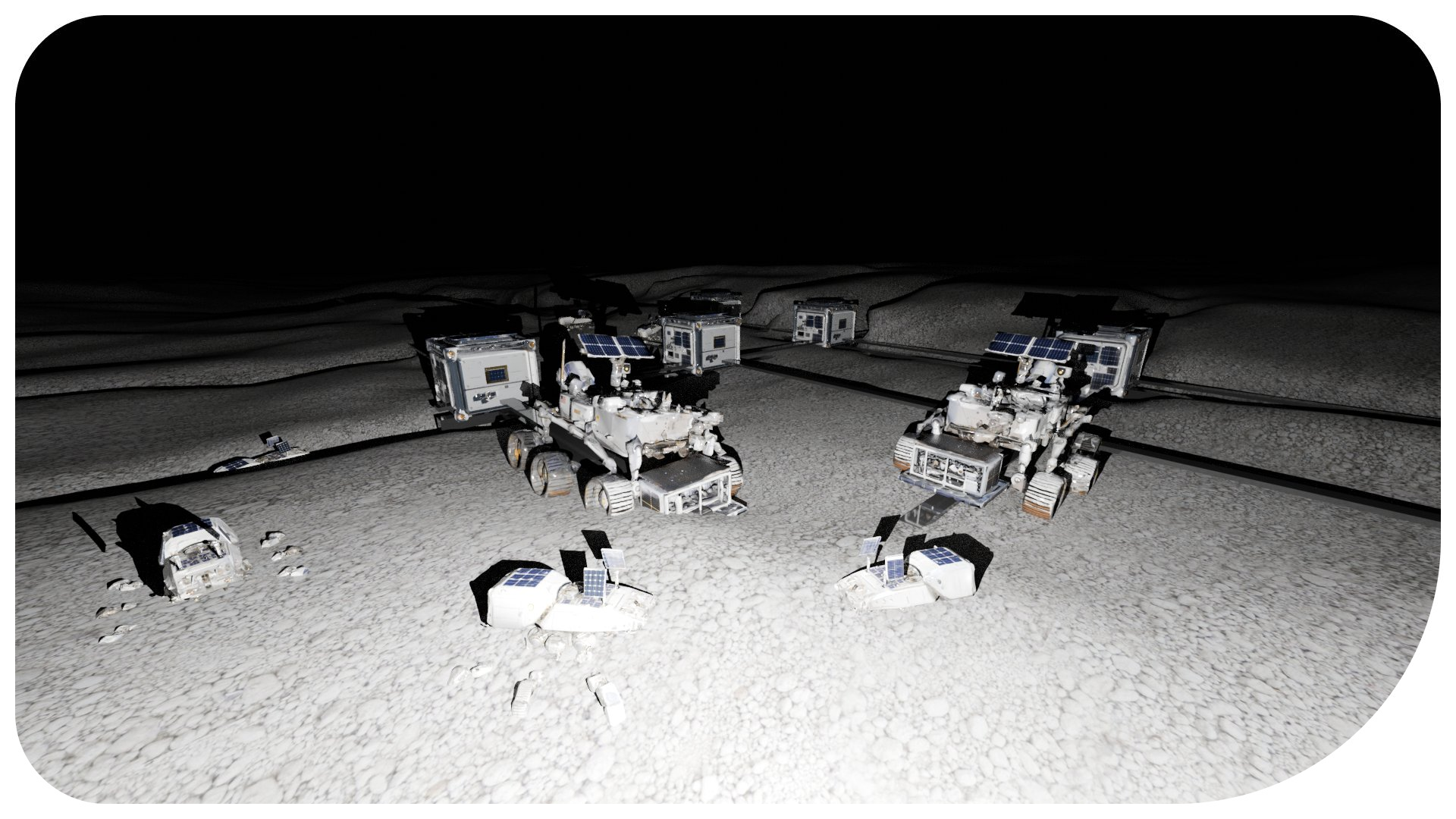
It was slow going. K’s last position as a monitor on undersea mining rigs had at least offered a degree of whimsy. At any moment, some deep-benthic creature might drift across the feed. But this was desolate. It required serious squinting and proficiency with the zoom just to register the movement of the work bots she was supposed to be watching.
Their tempo of progress was uncanny. It took weeks of careful comparison to old footage before she could tell that form was in fact emerging from the mounds of grey-white regolith. And when she did catch it, K couldn’t help but feel she was watching history in reverse—as if striations and outcroppings of stone were slowly assembling into something formal, human even, like a civilization rising out of ruins.
She understood what was happening technically. It was her job to keep pace with the system planners’ directives on the CAD overlay, cross-referencing the digital twin against what the cameras actually showed. Her other posts had been busier. This one had an eerie stillness to it: an elemental substrate drifting into forms, seemingly timeless in unbroken patterns of light, cast into relief by striking shadows across the lunar surface.
II
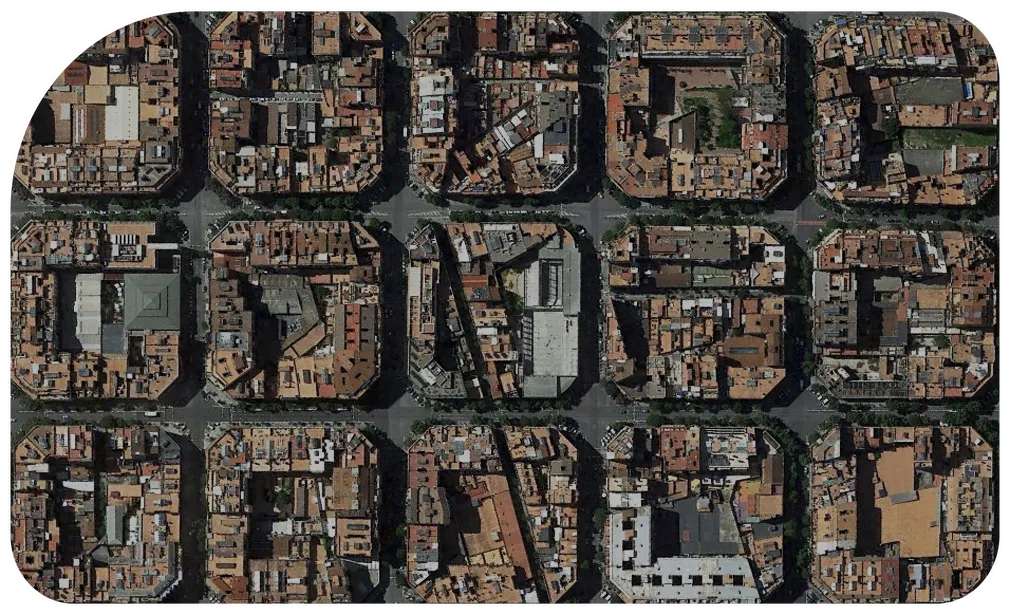
The walk from K’s apartment to the monitoring station took twelve minutes through Eixample—twelve minutes of Cerdà's grid, the octagonal intersections repeating with the regularity of a logic board. She barely noticed it anymore, but some mornings the symmetry nagged at her: the blocks here and the parcels up there obeyed a similar compulsion. Circulation first, inhabitation later.
URBE had printed that idea into its onboarding materials. Urbanización—the company’s namesake concept, borrowed from the 19th-century Catalan engineer who argued that a city’s essence lies in movement, exchange, and material-energetic transformation, not in the people who happen to live there.1 It was a useful frame for a company whose only permanent settlement had no human residents.
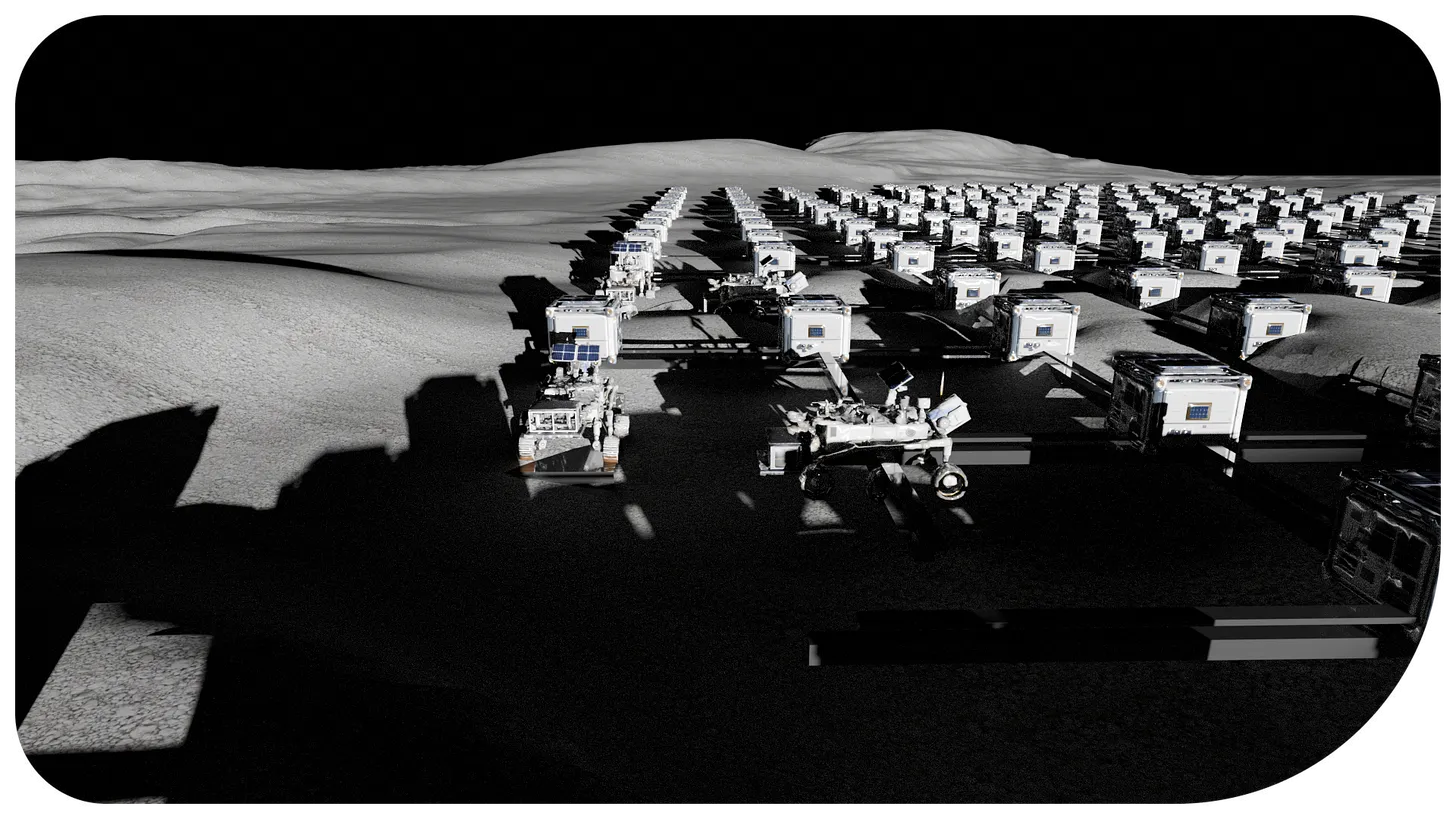
On screen, the machines worked in species. Some were almost indistinguishable from old Soviet Lunokhods—squat, patient, rolling on wire-mesh wheels across terrain their designers had studied from photographs taken half a century ago. Others were small and crab-like, kicking off the surface in weak gravity to reposition or ferry components to the harvesters: big, slow machines that hummed through regolith, sieving and collecting. In front of a harvester, pristine lunar plane. Behind it, a logistical landscape—parcels, 3D-printed pipe segments, an occasional coffee mug as a premium for future human visitors. Matter patiently mobilized in the name of circulation.
URBE’s census, updated daily on K’s dashboard: 0 humans. 3 species of plants and algae (sealed bioreactor, Parcel 7). 24 lunar bots. 2 harvesters with integrated regolith sieving, solar furnaces, and 3D printing arrays. A ruin of a city to come.
III
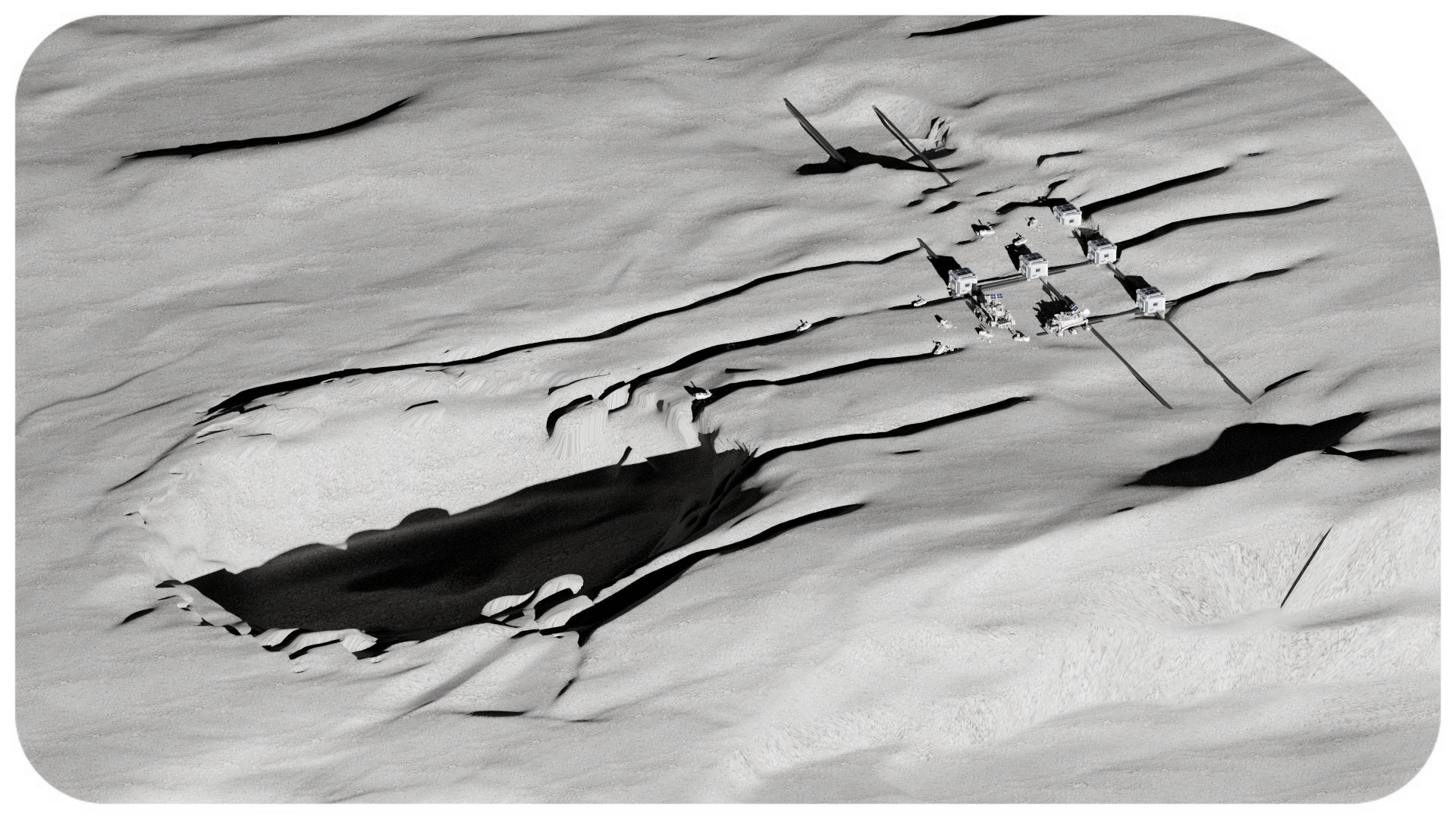
Halfway through her shift, K had already mapped progress over the last 24 Earth hours, logged tasks, and finished her weekly composite update to the digital twin. She switched to swarm view.
The screen became a mosaic of perspectives—each bot’s camera feeding a tile in the grid. Two teams were active, with two more in transit from the Lagrange staging depot. She followed Team A, working on something that could have been easily mistaken for a brownfield. It had gone up in four months, one parcel at a time. Through the swarm’s stitched 360° feed, she caught a dust cloud from a harvester cresting a berm.
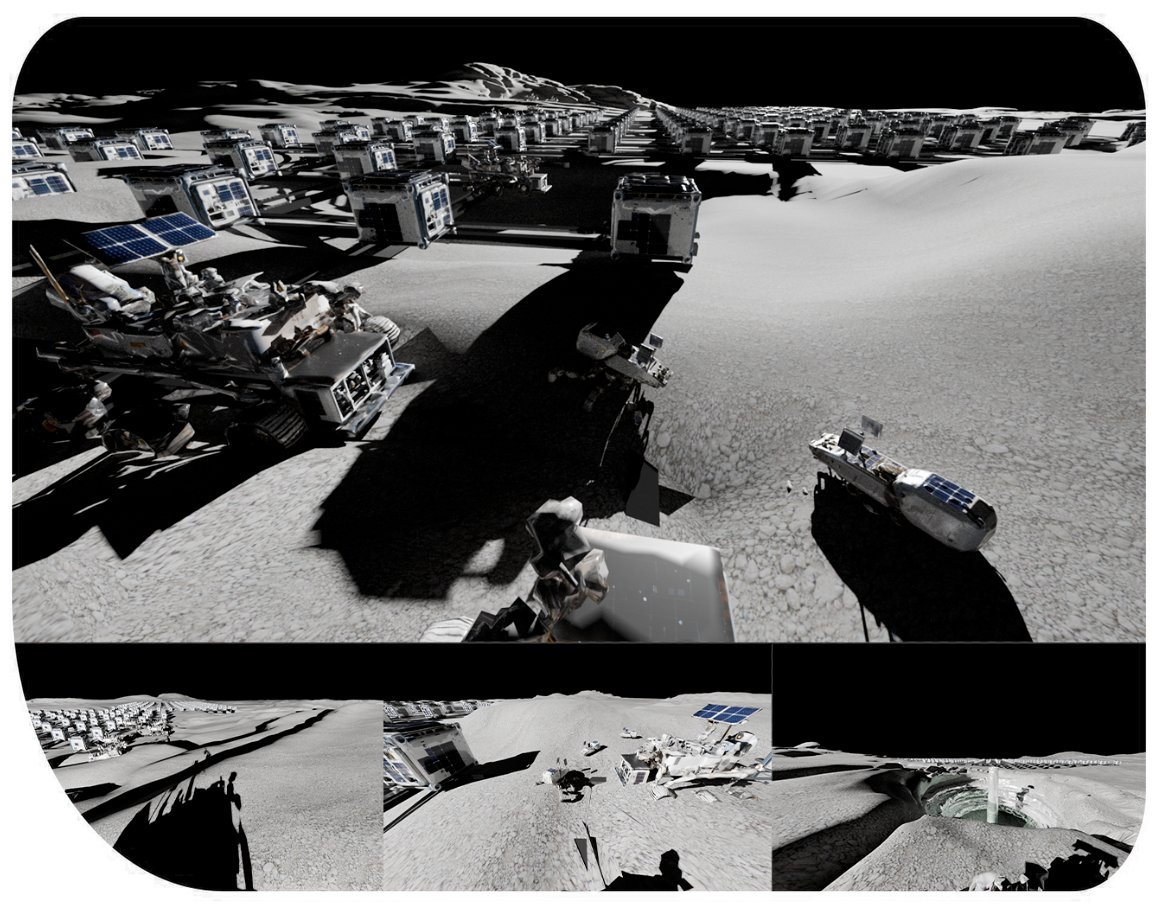
The cloud hung. No wind to disperse it, only electrostatics and the slow arithmetic of lunar gravity. K thought about regolith—its particles jagged, abrasive, never weathered smooth (because the Moon has no erosion). She thought about the photographs of Apollo astronauts with dark smudges across their visors and gloves, and about how the future inhabitants of whatever URBE was building would cope with that powder in every seal and joint. Even the machines hated it. Every few cycles, some mechanism seized, and K’s job was to route a maintenance sub-swarm to the site—three or four crab-bots converging on the stalled unit, prying dust from actuators with compressed gas and static brushes, a procedure that looked, on the mosaic feed, like small animals grooming a larger one.
She logged the intervention time. Seventeen minutes. Acceptable.
IV
Near the end of her shift, K pulled up the projection layer—the twin extrapolated forward at the current build rate. The software rendered six months out: a network of connected parcels, pipe grids carrying processed volatiles between nodes, a second bioreactor pod, a landing pad with plume-deflection berms printed from sintered regolith. Twelve months: a power distribution ring, three more harvesters, the first sub-surface thermal shelter. The projection didn’t show people. It showed capacity—volume, flow, shielding tolerances; the minimum viable metabolism of a place that could, in principle, be occupied.
K filed her logs, timestamped the twin, and closed the monitoring interface. The walk home took twelve minutes. Eixample’s grid was lit up, restaurants and balconies full with the particular energy of a city that had been designed for circulation and then, over a century and a half, filled with lives its engineers could never have imagined. She looked up. The Moon was a pale smudge above Sagrada Família, its surface carrying, somewhere in the southern highlands, the faint and unfinished imprint of the same idea.
In his Teoría General de la Urbanización (1867), Ildefons Cerdà coined the term “urbanization” (urbanización) and argued that the city’s essence lies in circulation (vialidad), movement, and material-energetic exchange rather than static settlement.
For accessible English-language overview of Cerdà’s plan for Barcelona, see: Aibar, E. & Bijker, W.E. (1997). “Constructing a City: The Cerdà Plan for the Extension of Barcelona.” Science, Technology, & Human Values, 22(1), 3–30. https://doi.org/10.1177/016224399702200101.